
Advanced Neutron Reflectometry Data Analysis for Soft Matter Systems#
Introduction#
In this tutorial, you will fit layer models to experimental reflectivity datasets and use these fits to gain quantitative information about the molecular structure of material across a buried interface. To do this you will use the RasCal 2 software which calculates slab layer models using Abeles matrix formalism, which is conceptually very similar to Parratt’s recursive formalism which is also used in reflectometry data analysis.
In these approaches, each layer is described by its thickness, roughness and scattering length density (SLD, ρ). The thickness of each layer is used to determine the phase of the reflected waves from each “slab” layer interface (top and bottom). Kiessig fringes in the reflectivity data are due to interference between these reflected waves.
More information on the mathematics of Parratt’s recursive formalism is available in PhysRev 95, 359.
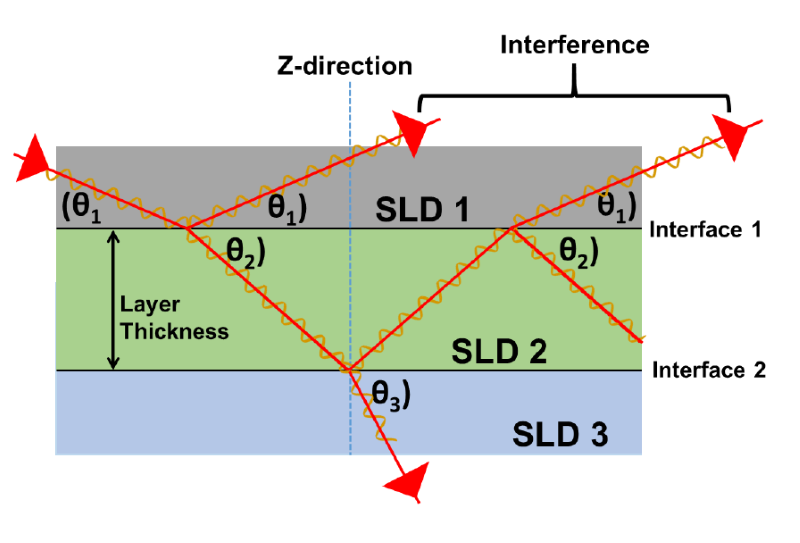
The “slab” layer model is used to calculate model reflectivity data by both the Abele’s matrix formalism and Parratt’s recursive formalism. The difference in scattering length density (ρ) at an interface and the angle/wavelength of the neutron beam give the magnitude of reflection while thickness of the layer and its effect on the phase difference between the top and bottom reflections gives rise to Kiessig Fringes.#
In the following sections, you will start by examining the structure of a silicon-D2O interface using the RasCAL’s model building GUI followed by fitting the same data using a custom model fitting. Then, the structure of a bilayer of 1,2-dipalmitoylphosphatidylcholine (DMPC) will be examined using multiple solution isotopic contrasts firstly with a simple “volume” fraction model followed by analysis using a more advanced “area per molecule” model. The tutorial data required for this will be the reflectivity data from the ISIS neutron training course solid-liquid flow cells practical on the OFFSPEC reflectometer. Finally, we will take a look at a complex layer structure with a composite fringe pattern from a multi-layered membrane complex.
Important
Download the tutorial data to follow along in the next sections.